
Electronic Cascade
|
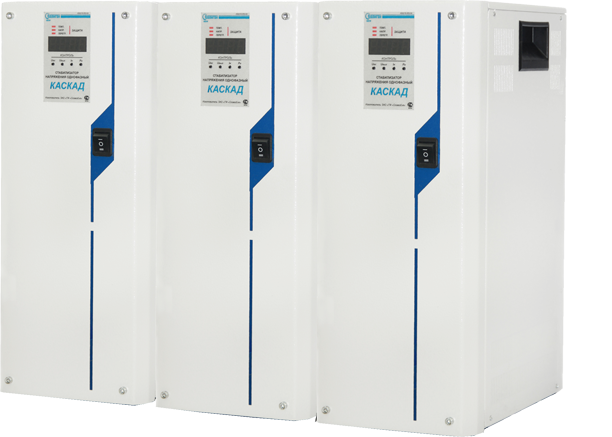
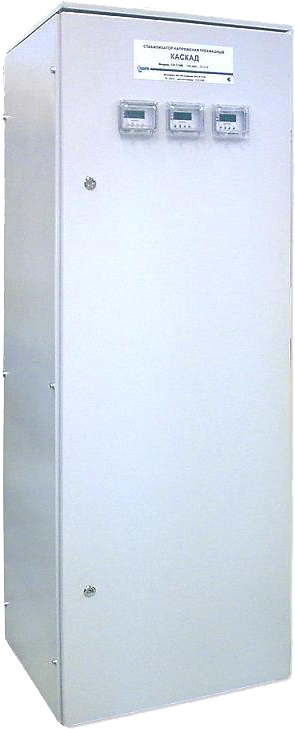
Three-phase Cascade stabilizersare made in 2 execution options depending on power:
|
|
VOLTAGE STABILIZERS THREE-PHASE
ELECTRONIC CASCADE |
|
|
|
Electronic Cascade stabilizers
|
Electronic Cascade stabilizers provide:
- stabilization of tension in the wide range of entrance tension, without emission of hindrances in a network and distortions of a form of the feeding tension;
- automatic shutdown of loading at decrease (increase) of tension of a network is (higher) than admissible value and return to a working condition after normalization of tension below;
- protection of loading against electromagnetic hindrances of a power line and clearing of powerful pulse hindrances of atmospheric and industrial character.
Multistage system of protection of Cascade stabilizers:
|
|
Electronic stabilizers as management can be divided into 2 types:
- stabilizers on electronic keys — the relay
- stabilizers on simistors/ tiristors
Relay voltage stabilizers carry to the most reliable. Adjustment of switching of windings of the transformer is carried out by means of electronic keys. The electronic key is couple the transistor – the relay. Such electronic key isn't sensitive to hindrances of a network and itself isn't their source.
Are a part of a relay voltage stabilizer the microcontroller operating work of electronic keys, the autotransformer and elements of protection against radio - and pulse hindrances. Electronic keys switch branches of the autotransformer with high speed, and use of modern materials for electronic keys provides quantity of kommutation to several million that gives the grounds to speak about the long term of no-failure and reliable operation of such stabilizer.
Advantages of electronic and relay voltage stabilizers:
- high speed of working off of indignation;
- reloading ability to quadruple within 10 seconds as because of the voltodobavochny transformer, directly the chain of loading doesn't switch the relay and works with smaller currents, in more favorable mode;
- tension form which isn't distorted in the absence of the distorting elements;
- rather wide temperature range limited from below and from above to the temperature characteristic of the relay;
- wide range of stabilization which is defined by the transformer;
- independent stabilization of phases, whose distortion doesn't influence quality;
- good work in noisy industrial networks (the switching element isn't sensitive to hindrances, forms of current and tension).
Differences of relay stabilizers from the thyristor:
- Electronic keys (relay) allow to work with overloads in 1000% while for the thyristor stabilizer the admissible overload makes only 20-40% during units of seconds, then the device should be switched off (automatic equipment) because of danger of an overheat of a crystal and thermal breakdown.
- In relay stabilizers there are no the distorting elements.
- In relay stabilizers (on the example of the Cascade) thanks to the original scheme of regulation not in power, and in a secondary chain, an isklyuchna the possibility of short circuit of windings of the autotransformer inherent in the scheme with thyristor management at its spontaneous opening (at lightning discharges, pulse hindrances).