
Single-phase
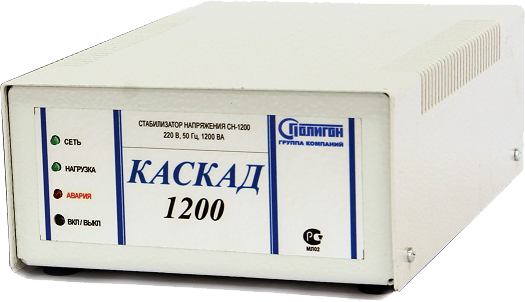
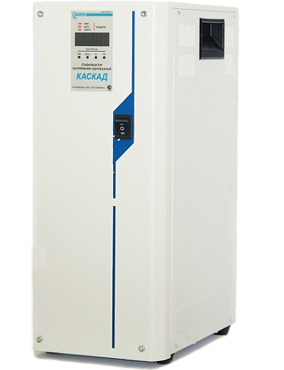
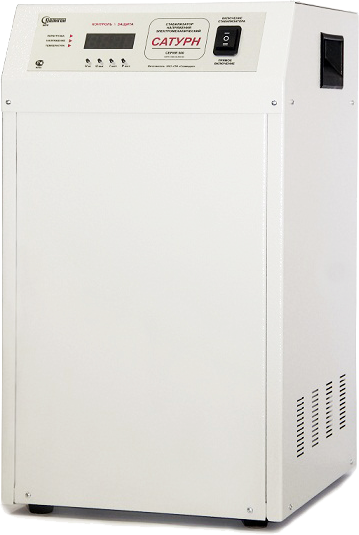
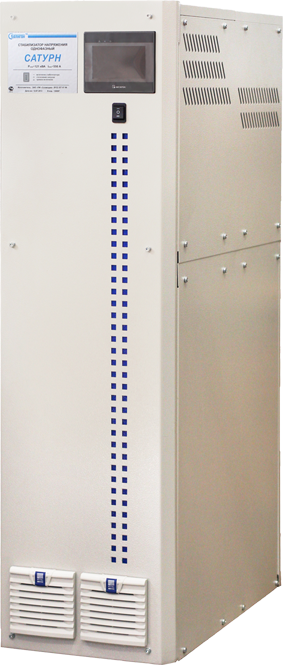
In the modern market it is possible to choose stabilizers in any parameters:
- the form appointments – household or industrial
- price category
- technical parameters
- the country producer
For a single-phase voltage stabilizer it is necessary to determine the power and other additional parameters for selection of model.
1 – Capacity
Power of the single-phase stabilizer is recommended to be chosen with a small stock, proceeding from the total power of consumers of tension on object. It is possible to choose the stabilizer of necessary power among electronic Cascade stabilizers from 0,8 to 20 kVA, or among electromechanical "Saturn" from 4 to 140 kVA.
If loading at inclusion gives big starting currents (the large equipment, transformers, etc.) or is nonlinear, the producer is obliged to guarantee normal operation of the stabilizer in these conditions.
2 – Range of entrance tension
For a competent choice of the device it is desirable to know the range of fluctuations of tension in a network. The stabilizer price depends on the range of entrance tension: the range is wider, the cost is more.
3 – Quick action
Sometimes an important condition for the consumer is the speed of working off of entrance tension. It is recommended to learn this parameter directly from the producer.
4 – Existence of functions of protective shutdown
The following options of protective shutdown are possible:
- Shutdown on output tension – works at tension exit for the range with which the stabilizer can cope. Shutdown happens both on top, and on the lower bound of tension and is returnable function (at normalization of output tension the stabilizer connects loading again).
- Shutdown on an overload – for protection against an overload works a safety lock or electronic shutdown (it is more convenient as works taking into account starting currents of loading and doesn't demand replacement of safety locks).
- Shutdown on temperature –occurs at excess of ambient temperature or overheating of the device (for example if at installation of the stabilizer sufficient ventilation isn't provided).
The first type of shutdown ensures safety of loading while two other types of shutdown are directed on protection of the equipment.
5 – Accuracy of output tension
|
Accuracy of adjustment of voltage stabilizers |
Parameters |
| High-precision | 220 ± 1% (218 – 222 V) |
| Average accuracy | 220 ± 3% (214 – 226 В) |
| Low accuracy | 220 ± 7% (205 – 235 V) |
The cost of stabilizer depends on the accuracy, that's why it is better to consult with the expert about the model, or to study tension parameters necessary for equipment which will be connected to the stabilizer.
For protection of household appliances the stabilizer with an average accuracy of correction suffices, and the stabilizer of high precision is necessary for work with the exacting medical or industrial equipment.
6 – Type of adjustment of tension
- Smooth adjustment is the main property of electromechanical stabilizers ("Saturn") and stabilizers on magnetic amplifiers.
- Step adjustment consists in switching of windings of the transformer and is peculiar to electronic and relay voltage stabilizers ("Cascade").
7 – Temperature range
Almost all voltage stabilizers are intended for operation at above-zero temperature, in the protected room. If it is necessary to establish a single-phase voltage stabilizer on the street or in not heated rooms, you should discuss it with the supplier or the producer.
8 – Noisiness
- The highest noise level is created by voltage stabilizers on magnetic amplifiers.
- Small noise level characterizes electronic stabilizers: switching of steps at them happens silently, but is audible operation of the fan.
- Insignificant noise from the servo-driver electromechanical voltage stabilizers make "Saturn".
- Small click is audible when switching steps at relay stabilizers ("Cascade").